15 kV insulation testers for HV & EHV assets
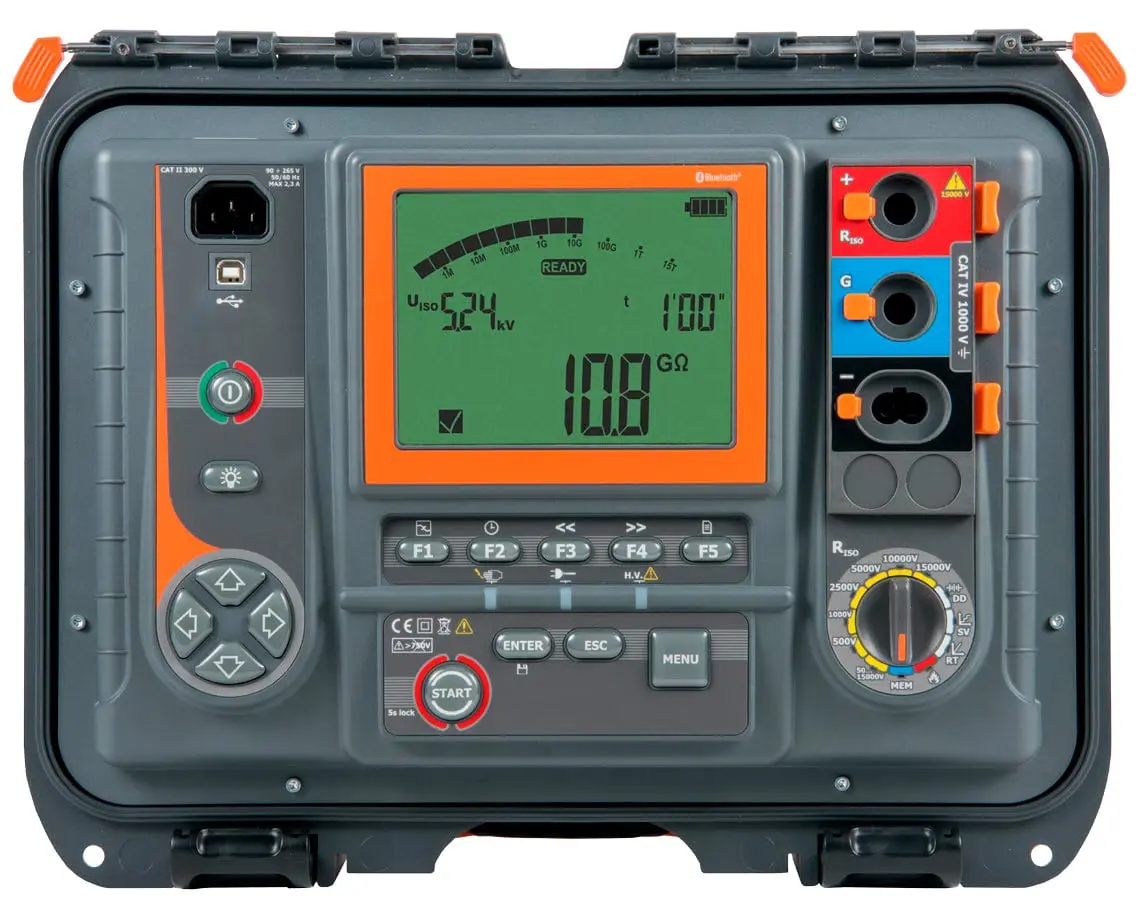
Insulation resistance testers up to 15 kV provide the highest test voltage and the widest measuring range in the family, for the most demanding high- and extra-high-voltage assets. A 15 000 V DC source reaches tens of TΩ and, per ANSI/NETA guidance, is applied to apparatus rated above 34.5 kV. The Amperis range for the electrical sector includes 15 kV instruments for large generators, EHV cables and GIS where maximum reach and noise rejection are essential.
What it measures and how it works
The 15 kV range exists for two reasons: extra-high-voltage assets need higher test stress, and very large, very clean insulation systems reach resistances only a top-range instrument can resolve. At full voltage the tester runs PI, DAR, step-voltage and dielectric discharge tests, logs capacitance and leakage current, and — most importantly — rejects the heavy interference present around EHV plant so the measurement stays trustworthy.
How to choose the right tester
- Match voltage to apparatus: ANSI/NETA applies 15 kV DC tests to equipment rated above 34.5 kV.
- Verify the top of the measuring range and resolution at very high resistance.
- Demand the strongest available noise immunity for energised EHV environments.
- Require full diagnostic suite — PI, DAR, DD, step/ramp — with capacitance and current logging.
- Check charge current, automatic discharge and robust safety interlocks for high-energy testing.
Specifying for a generation plant or EHV substation? Our engineers can help.
Applications
The 15 kV range serves the largest HV/EHV assets and laboratory work:
- Large generator and synchronous-machine stators
- EHV power cables and long cable runs
- Gas-insulated switchgear (GIS) and HV substations
- Apparatus rated above 34.5 kV
- High-range laboratory and acceptance diagnostics
Applicable standards
Amperis instruments are referenced to IEC/EN standards, not national PN/PL designations:
- IEC/EN 61010-1 — instrument safety and measurement category
- IEC/EN 61326-1 — electromagnetic compatibility (EMC)
- IEEE 43 — insulation resistance and PI for rotating machines
- IEC 60034-27-4 — off-line winding insulation resistance
- ANSI/NETA ATS/MTS — acceptance/maintenance values, including >34.5 kV apparatus
Frequently asked questions
When is 15 kV actually required?
When apparatus is rated above 34.5 kV, ANSI/NETA recommends a 15 kV DC test; large generators and EHV cables also need the wider range to characterise high-resistance insulation that lower voltages cannot resolve.
Does higher voltage risk damaging the insulation?
DC insulation resistance testing is non-destructive when the test voltage is matched to the asset rating. Controlled ramp profiles and the step-voltage method apply stress progressively so weakening insulation is detected, not punctured.
10 kV or 15 kV — how do I decide?
Choose 10 kV for most HV substation and generator work; step to 15 kV when assets exceed 34.5 kV or when the very top of the resistance range and the strongest noise rejection are required.
Technical resources
Step down to 10 kV or 5 kV for HV and MV duties, and combine with partial discharge detection, transformer testing or our dielectric test sets. Request a quote for the right high-voltage con