10 kV insulation testers for HV substations
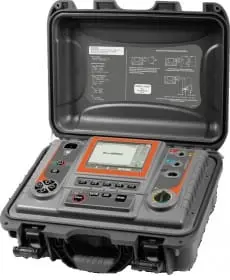
Insulation resistance testers up to 10 kV are built for high-voltage diagnostics in substations and power plants. A 10 000 V DC source and a measuring range that reaches tens of TΩ let maintenance teams assess large generator stators, long HV cables, transformers and GIS — assets where insulation resistance is high and electrical noise is severe. The Amperis range for the electrical sector includes 10 kV instruments for demanding field conditions.
What it measures and how it works
At up to 10 kV the limiting factor is no longer the source but interference. Currents induced by nearby energised equipment can swamp the tiny leakage being measured, so a 10 kV tester combines a high-current guard, strong filtering and noise rejection to hold a stable reading in an energised yard. PI, DAR, step-voltage and dielectric discharge methods all run at full voltage, and capacitance and leakage-current readouts round out the diagnosis.
How to choose the right tester
- Confirm the measuring range — healthy HV insulation can sit in the tens of TΩ.
- Prioritise specified noise immunity (rated interference current it can reject) for live substations.
- Require automatic PI, DAR, DD and ramp/step tests with on-board storage.
- Check the guard terminal performance and the short-circuit/charge current available to settle large capacitances.
- Look for safety interlocks, fast automatic discharge and a clearly stated measurement category.
Need to specify an instrument for a particular substation? Contact our engineers.
Applications
The 10 kV range covers high-voltage transmission and generation assets:
- Generator and large-motor stator windings
- HV power cables and accessories
- Power transformers and bushings
- Gas-insulated switchgear (GIS) and HV switchgear
- Substation acceptance and maintenance diagnostics
Applicable standards
Amperis instruments are referenced to IEC/EN standards rather than national PN/PL variants:
- IEC/EN 61010-1 — instrument safety and measurement category
- IEC/EN 61326-1 — electromagnetic compatibility (EMC)
- IEEE 43 — insulation resistance and PI for rotating machines
- IEC 60034-27-4 — off-line winding insulation resistance
- ANSI/NETA ATS/MTS — acceptance and maintenance test values
Frequently asked questions
Why does noise immunity matter at 10 kV?
In an energised substation, capacitive and inductive coupling injects interference currents into the test leads. Without strong filtering these distort or mask the leakage current, so a tester’s rated noise rejection often matters more than its raw voltage.
Is 10 kV suitable for generator stators?
Yes. Large stator windings need higher test voltages and the tens-of-TΩ range to characterise insulation properly, and IEEE 43 PI testing on these machines is a core 10 kV application.
What does the guard terminal do here?
The guard diverts surface-leakage current — across dirty or humid bushings and terminations — away from the measuring circuit, so the reading reflects true volume resistance rather than surface tracking.
Technical resources
Compare with 5 kV for MV work or step up to 15 kV for the highest range; combine HV diagnostics with transformer testing, partial discharge detection or our dielectric test sets. [Request a quote](https://amperis.com/en