Battery testers: internal resistance & voltage
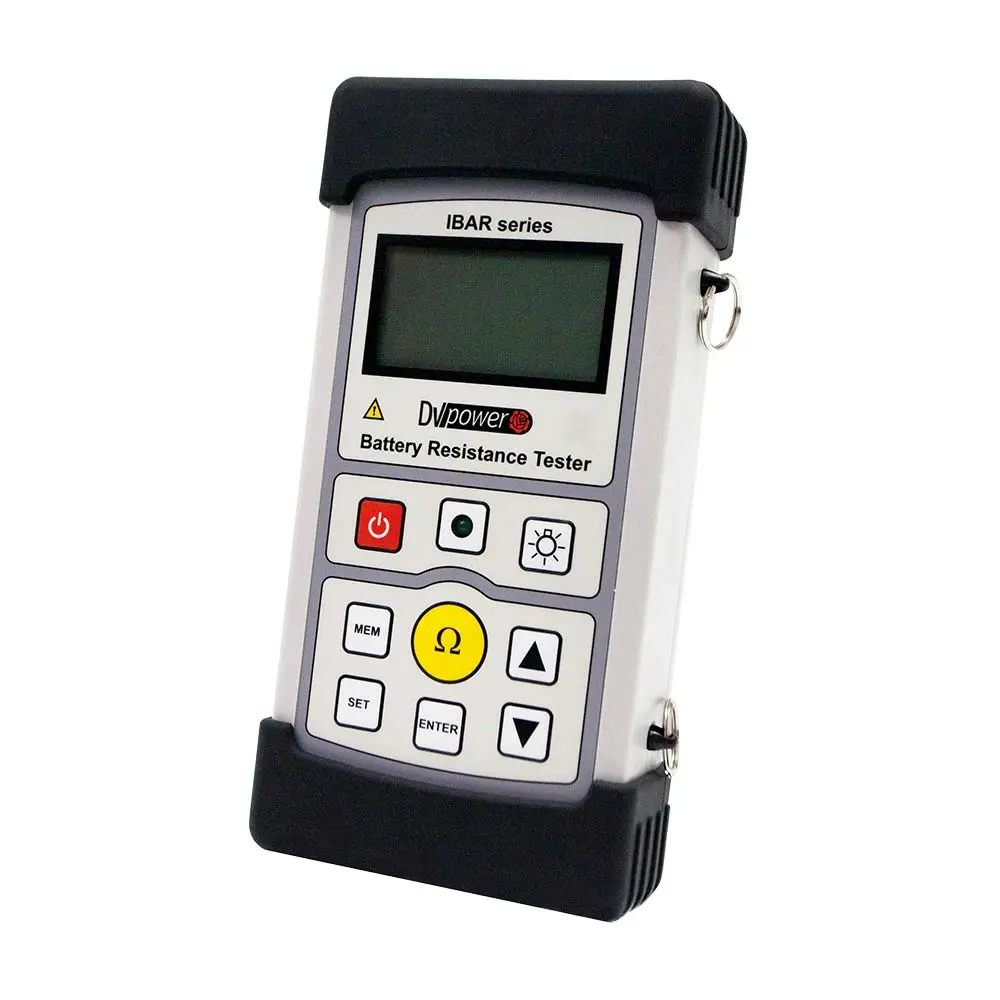
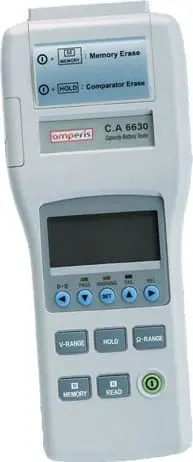
Battery testers assess the condition of stationary cells and strings without a full discharge — measuring internal resistance, impedance or conductance and cell voltage — to find a weak cell before it lets the bank down. The Amperis range for the electrical sector includes handheld and rack testers for vented (VLA) and valve-regulated (VRLA) banks.
What it measures and how it works
The tester reads each cell’s internal ohmic value (resistance, impedance or conductance) and trends it against the commissioning baseline, together with individual cell or jar voltage and inter-cell connection resistance. Because a rising ohmic value signals a degrading cell, this fast, in-service check gives early warning between the periodic capacity (discharge) tests that remain the definitive measure of stored energy.
How to choose the right tester
- Choose the ohmic method (resistance, impedance or conductance) and baseline trending.
- Check cell-voltage and connection-resistance measurement.
- Look for memory, app or PC transfer for trend reports.
- Decide between handheld spot testing and automatic string testing.
- Confirm suitability for your chemistry (VLA, VRLA, Ni-Cd).
Not sure which tester fits your battery room? Do not hesitate to contact us.
Applications
- Substation and telecom battery rooms
- UPS and data-centre strings
- Periodic IEEE testing programmes
- Acceptance and condition-based maintenance
Applicable standards
Amperis instruments are referenced to the IEC/EN and IEEE framework (not national PN/PL designations):
- IEEE 1188 — VRLA maintenance and testing (internal ohmic every 6 months)
- IEEE 450 — vented (VLA) maintenance and testing
- IEC 60896 — stationary lead-acid batteries
- IEC/EN 61010-1 — instrument safety
Frequently asked questions
Ohmic test or capacity test?
Ohmic (resistance/impedance/conductance) testing is a fast, in-service early warning; a capacity (discharge) test is the definitive proof of stored energy. Programmes use both.
What ohmic change is significant?
Under IEEE 1188, an internal ohmic value more than about 20% above the commissioning baseline marks a VRLA cell as suspect and due for closer attention.
Can I test without taking the bank offline?
Yes. Ohmic and cell-voltage tests are made on the float-charged bank, so the backup stays available during the check.
Technical resources
Return to the battery maintenance and charging range or pair with low-resistance ohmmeters for connection checks. Request a quote.